

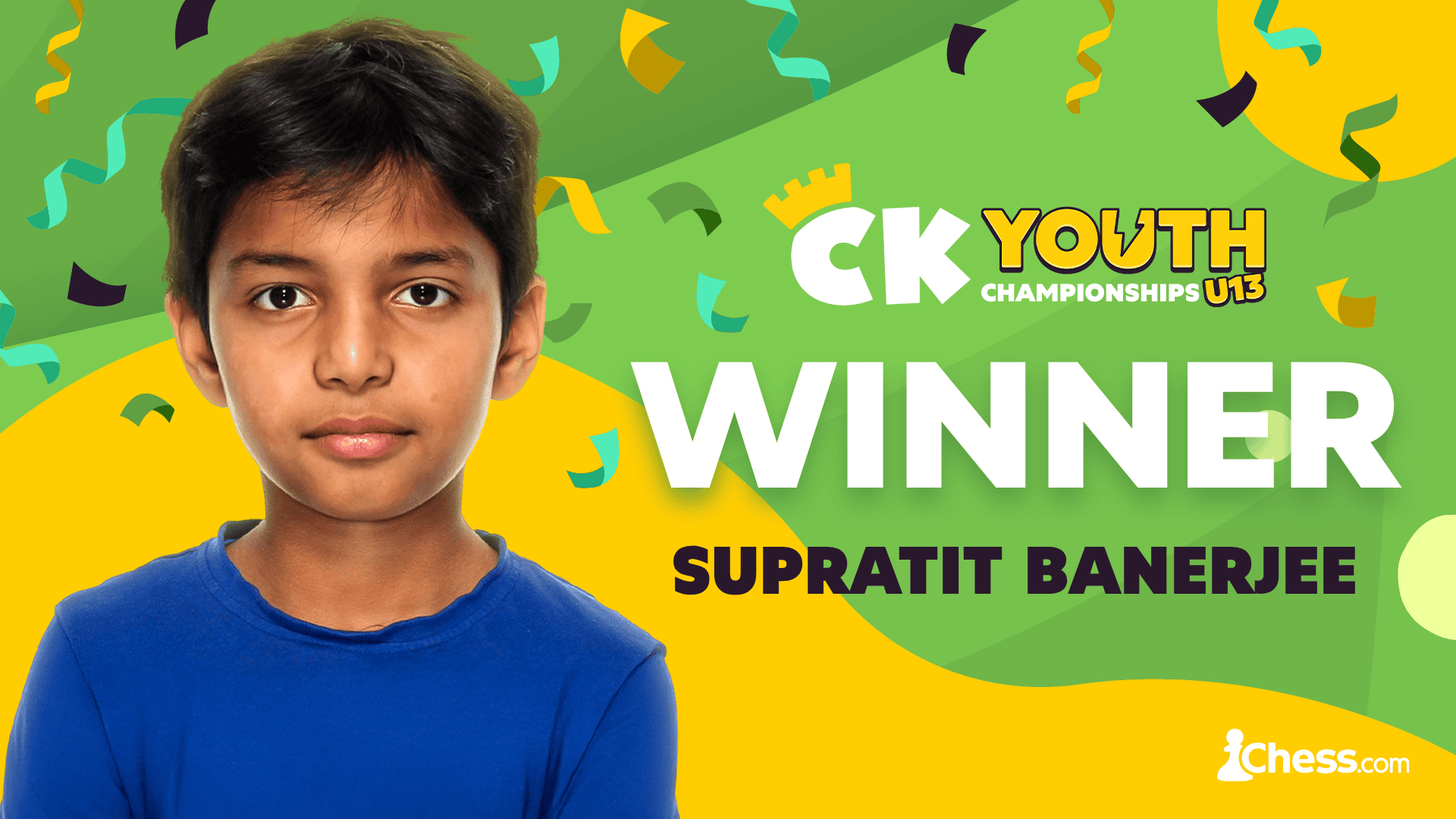
10-year-old WIM Bodhana Sivanandan scored an incredible 12/13 to reach the Final of the 2026 Under 13 ChessKid Youth Championship, but ultimately fell to her English rival FM Supratit Banerjee 3.5-1.5. Banerjee beat another 10-year-old, FM Ashwath Kaushik, in the Semifinals on the way to winning the $1,500 top prize a day before his 12th birthday.
Final Standings
Group A: Banerjee Dominates, Kaushik Beats Protopopescu In Armageddon
Group B: Sivanandan On Different Planet, Guo Snatches Second
Knockout: Banerjee Stops Sivanandan To Win Title
Knockout Bracket

The 2026 ChessKid Youth Championships features two 12-player events, one for players 13 and under (on January 1st, 2026) and the second for players 16 and under. Each has a $5,000 prize pool, with $1,500 for the winner.
Each event starts with two groups of six players, who play each other twice at 3+1 blitz. Only the top two go forward to the Semifinals, played as best of four games, while the Final is best-of-six.
Both groups were won by the great hopes of English chess.
Group A: Banerjee Dominates, Kaushik Beats Protopopescu In Armageddon
It’s enough to give an idea of how competitive this 10-round battle was that in the very first round the youngest player in the whole event beat the eventual winner in brilliant style.
There were three nine-year-olds in action across the two groups, but CM Marc Barcelo from Spain (born in August, 2016) is five months younger than CM Luca Protopopescu and Hardy Gu (born in March). Barcelo has a FIDE classical rating of 2078 compared to Banerjee’s 2322, but he’s rising fast. He’d warmed up to the event by gaining 52 points in Pamplona.
Barcelo played some stunning chess, but ultimately missed out on the knockout when he lost a position he was winning in the final round.
Banerjee, meanwhile, went on to win seven games, lose two, and draw none as he finished 1.5 points ahead of the chasing pack. He could have some fun along the way.
Why give mate-in-one with 50.Qg6# when you can promote to a knight! https://t.co/Cgx9hR7uOI pic.twitter.com/Xajaar1BfJ
— chess24 (@chess24com) February 21, 2026
He explained of the lack of draws: “It was very double-edged! All of the games were always swinging to one side’s favor or another. The openings I was playing, and the style of my opponents—there was never really going to be too many draws.” After playing 1.e4 in the first-round loss, Banerjee played 1.g3 in all his remaining games with White (four wins) and 1…g6 or 2…g6 in all his games with Black.
Why that system? “1.g3 basically came one time when I was playing some bullet online and I was just playing 1.g3 and I won dozens of games with it,” while it also simplifies preparation, since as he explained, “On the week days I’m usually able only to give one to two hours because of a lot of schoolwork.”
The battle for second place was intense, with all but one of the other players in with a chance going into the final round. What followed was some incredible drama. Kaushik, playing from Singapore with midnight approaching, seemed to have wrapped up the spot when he beat Barcelo, since Protopopescu was completely lost against the struggling FM Ali Poyraz Uzdemir. Uzdemir even ended the game with two extra queens, but he’d fallen into the trap of countless despairing chess players down the ages and given stalemate—when 56.b4# was mate-in-one.
Ouch! Ali Poyraz Uzdemir makes a new queen and it’s stalemate… when he could have given checkmate-in-one! The draw means Luca Protopopescu reaches a playoff for the final place in tomorrow’s Semifinals: https://t.co/AxI0a01VG9 pic.twitter.com/v0QX6d3ov6
— chess24 (@chess24com) February 21, 2026
That meant a two-game 3+1 playoff which would be followed, if needed, by armageddon—and it was needed!
Protopopescu kept up the momentum to deliver checkmate in the first game, but Kaushik hit back in the second—it was understandable Protopopescu again played on to checkmate in a position he was two queens down…
…since he’d also pulled off this incredible save against Barcelo earlier.
That meant bidding armageddon, with Kaushik winning the right to play Black by offering to play with three minutes 51 seconds to his opponent’s bid of four minutes 15 seconds. Protopopescu had five minutes and had to win with the white pieces, which looked highly likely when he won a pawn with a dominant position. He somehow overlooked the point of 18…Nc8, however, and played 19.Bb3??, leaving his queen on d6 to be captured.
Luca hangs his queen in a close to winning position! https://t.co/SHBkMEv6wy pic.twitter.com/lX8jFO4px1
— chess24 (@chess24com) February 21, 2026
So Banerjee and Kaushik had qualified from group A, and it was time for group B.
Group B: Sivanandan On Different Planet, Guo Snatches Second
It’s an interesting question what would have happened if Sivanandan had lost a losing position in her first-round game against India’s 12-year-old FM Aarav Sarbalia. We never got to find out, however, since two knight forks took her from lost, to equal, to winning.
From there on she never looked back, as she won the next eight (!) games on the way to an epic 9.5/10.
It was all the more remarkable given that in the group only Gu had a lower rating than her 2163, though that’s a rating that’s about to change after she racked up 102 rating points in her latest event, the Graz Open in Austria.
It’s been quite a couple of weeks for Bodhana!
No big deal, just 10 years old and playing the biggest chess YouTuber @GothamChess, while the world’s best chess player, two Premiership footballers, and Anna Cramling all look on. pic.twitter.com/3XF207Wp6O
— Mike Klein (@ChessMike) February 11, 2026
In the ChessKid Championship there was some help—for instance, FM Reyaansh Chakrabarty unfortunately had to forfeit the first two rounds as he was completing a classical game in the Isle of Wight Masters—but mainly it was about Sivanandan’s incredible feel for endgames.
In round three, FM Linxi Zhu (favorite player GM Mikhail Tal) made the not immediately obvious blunder 48.Kb3? (48.Kd3!) and wasn’t given the slightest chance as Sivanandan methodically wrapped up the game while blitzing out her moves instantly.
As if to prove that wasn’t a fluke, she did the same in the next game against 13-year-old FM Ethan Guo, the oldest and highest-rated player in the championship.
A mouse-slip in round five was followed by another endgame grind in round six. Asked later if it was a plan to go for the endgame, Sivanandan, whose favorite player is third World Champion Jose Raul Capablanca, replied:
It wasn’t really a part of the tournament strategy, but I just tend to go into endgames a lot. I think maybe I should try and play more middlegame and opening positions, but it’s not really something that I’ve gotten recently, it’s just something I’ve been doing for a long time and it’s become like a habit now.
I just tend to go into endgames a lot.
—Bodhana Sivanandan
Sivanandan did show she could play fine attacks in rounds seven and eight, before in the final round she had the chance to reach an incredible 10/10. Although she was on the ropes for most of the game, it wouldn’t have surprised anyone if she’d managed to turn around the position in the final stages. Instead Guo made a draw.
Ethan Guo looks disappointed as he stumbles into a draw by 3-fold repetition, but a draw is all he needs to qualify with Bodhana Sivanandan to tomorrow’s Semifinals! https://t.co/5HagbKke9r pic.twitter.com/Wv1ZpSbINl
— chess24 (@chess24com) February 21, 2026
That proved to be enough to give Guo, 3.5 points behind, the second spot in the Semifinals. Zhu had won a stunning game in the penultimate round to keep level with Guo…
There was no good defense to Qc4+ next and the threat of checkmate.
…but in the final round he lost after missing a trick against Sarbalia.
The champion would be decided in Sunday’s knockout.
Knockout: Banerjee Stops Sivanandan To Win Title
Sivanandan was facing Kaushik in the Semifinals and didn’t slow down, as in the first game her opponent was unable to hold a tricky position on seconds. The passed a-pawn broke free.
In the second game Kaushik looked set to hit back after he broke powerfully in the center, but he lost his way, allowed Sivanandan to equalize, and, to no one’s great surprise, was comprehensively outplayed in the endgame.
Since it was best-of-four, Kaushik had to win on demand in game three to prolong the match—and that looked to be just what he was going to do, until at the very end he forgot to move his king to defend d1 before queening his pawn.
Bodhana is in the final after Ashwath Kaushik forgets to guard the queening square and spoils a completely winning position! https://t.co/sMH4pswWBV pic.twitter.com/gxG3MnYXVj
— chess24 (@chess24com) February 22, 2026
Perhaps the late hour in Singapore was the only explanation for that miss, but it meant Sivanandan, still unbeaten, was in the Final.
Her opponent would be Banerjee, who was playing the final day after having to miss out a year ago when he won his group but had an overlap with an over-the-board event.
It’s a curiosity that Sivanandan was bottom of the same group in 2025, winning only two games. Imagine how strong she can become by 2027!
The Semifinals got off to a tough start for Banerjee as he lost his way in tactics and fell behind against Guo, the only player in the event with a higher classical rating.
Banerjee was also in trouble in the second game, but equalized and then broke through to win and level the scores at 1-1. When he won again in game three he needed only a draw.
Banerjee took a 2-1 lead and needed only a draw, but the next game would be his 14th of 18 decisive games in a row!
Now it was Guo’s turn to strike back and level the match at 2-2, meaning they went to a two-game playoff.
A day earlier Banerjee had commented when asked for advice for players hoping to emulate him: “The most important thing is to keep enjoying playing the game and almost never losing hope, because losses are always inevitable but it’s really important to keep going.”
Losses are always inevitable but it’s really important to keep going.
—Supratit Banerjee
He bounced back again in the next game, catching Guo out with a tactical trick and going on to win smoothly.
Guo once again had to win on demand, but he was busted out of the opening in the final game and never got a chance.
That meant Banerjee faced his English colleague Sivanandan in the Final, and while he realized her strength, he wasn’t afraid: “Bodhana is obviously great in the endgame, as I could see when going through her games yesterday, but at the same time, I personally think I’m not that bad in the endgame!”
Bodhana is obviously great in the endgame… but at the same time, I personally think I’m not that bad in the endgame!
—Supratit Banerjee
We got to see the battle play out in the first game, where Sivanandan missed some chances in a tricky middlegame but looked to be taking over in the endgame, especially on the clock, as at the critical moment she had 14 seconds to Banerjee’s five. She overlooked a trap, however, and fell to a first defeat in 14 games.
Banerjee makes the critical breakthrough.
That first loss for Sivanandan turned into a second in the next game, when White’s opening went wrong and Banerjee was able to crash through with 28…Rxg3+! and a checkmating attack.
It was threatening to be a massacre when Banerjee built up a winning advantage in the third game, but a few inaccuracies and Sivanandan once more got to demonstrate some endgame magic as she built a fortress and held a draw.
That could easily have been a turning point, as Sivanandan built up a winning position in the next game, but for once the endgame let her down—she was unable to convert a two-pawn advantage in a rook endgame.
After 52.Ke3? (52.Kg4!) 52…Kf5! there was no way for White to win.
That left Banerjee needing only a draw in the fifth game of the six-game match, and that’s what he got, forcing a draw from a position of strength after Sivanandan had been forced to take risks to avoid a draw.
So Banerjee had won the match 3.5-1.5, but Sivanandan’s performance had emphasized how bright the future could now be for English chess.
Congrats to Supratit! Great performance too by Bodhana. The future is bright. 🏴 🌟 https://t.co/pVROcIFic9
— David Howell (@DavidHowellGM) February 22, 2026
It’s literally back to school for Banerjee, even on his 12th birthday the day after winning the tournament, but what are his plans? “I’m trying to get to 2400 and get my IM title soon, hopefully!”
I’m trying to get to 2400 and get my IM title soon, hopefully!
—Supratit Banerjee
And who does he look up to? “My heroes are young players who have achieved a lot, like Gukesh, for example, and Magnus.”
We’re going to see more young players who’ve achieved a lot in the Under 16 Championship in two weeks’ time, which includes the awesome trio of prodigies GM Yagiz Kaan Erdogmus, GM Andy Woodward, and IM Faustino Oro.
That’s far from the end of the talent on show, however, with the likes of IM Lu Miaoyi, FM Megan Paragua, IM Henry Tudor, IM Tani Adewumi, GM Sina Movahed, and 2025 Under-13 Champion IM Aaron Mendes also in action. That begins on March 7.
How to rewatch?
You can review the broadcast on Chess.com’s Twitch and YouTube. The games can also be checked out on our dedicated events page. The live broadcast was hosted by GM Arturs Neiksans and FM Mike Klein.
The ChessKid Youth Championship is Chess.com’s top event for the next generation of the chess elite. The under-13 section took place February 21-22, with two six-player groups where the players competed in a double round-robin. The top two players qualified for the knockout, where the semifinal was best-of-four and the final best-of-six. All games were played with the 3+1 time control and the prize fund was $5,000, with $1,500 for first place.
Previous coverage:
Prodigies Collide In Upcoming ChessKid Youth Championships Starting February 21
